


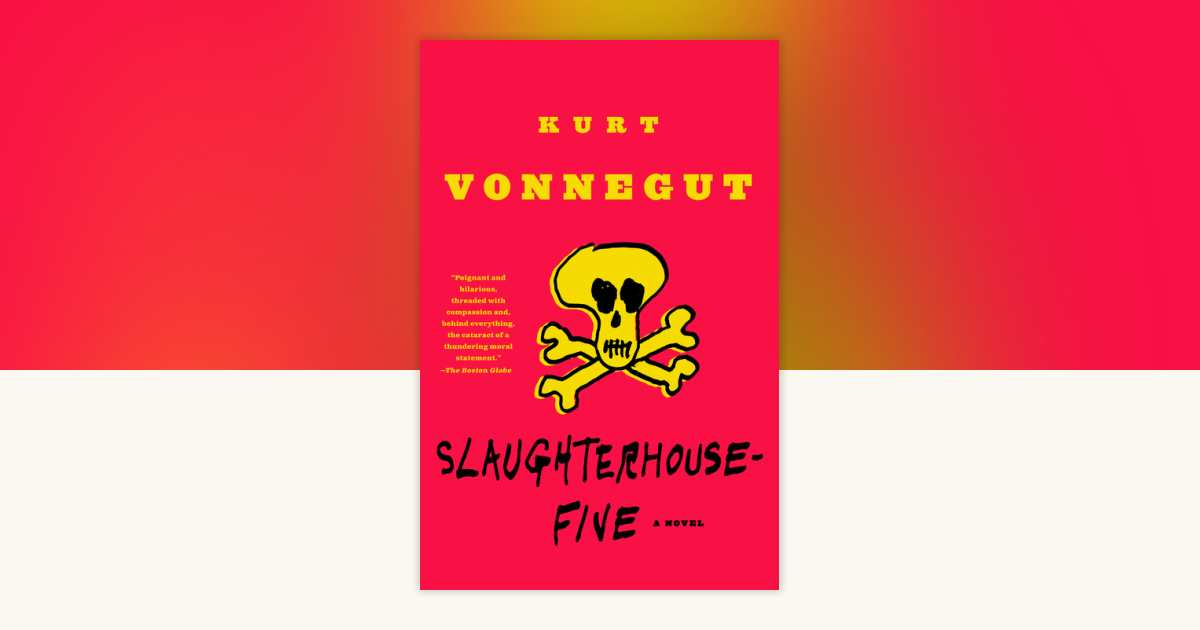
Slaughterhouse-Five is an experience that reshapes the way you think about war, memory, and what it means to be human. Kurt Vonnegut’s masterpiece defies conventional storytelling in the same way war defies conventional morality. Fragmented, circular, absurd, and devastatingly funny, the book feels less like a book and more like a stream of consciousness you inhabit.
At the center of the story is Billy Pilgrim, an unremarkable man who becomes “unstuck in time,” drifting involuntarily through moments of his life. This conceit is he perfect formal expression of trauma. Vonnegut understands that trauma is not linear. It does not move cleanly from beginning to end. Instead, it intrudes, repeats, loops, and collapses past and present into a single, disorienting now. Billy’s time travel mirrors the psychological reality of a survivor who cannot escape what he has seen.
RELATED: Kant: The Discipline of Reason in a Chaotic World
That experience is anchored in one of the most harrowing events of the twentieth century: the firebombing of Dresden. Vonnegut, who survived the bombing as a prisoner of war, refuses to aestheticize or glorify it. Instead, he renders the destruction with restraint, irony, and a profound moral exhaustion. The repeated refrain “So it goes” becomes both a shield and an indictment. It captures the numb resignation that follows mass death, while simultaneously forcing the reader to confront how casually we accept it.
What makes Slaughterhouse-Five extraordinary is its tonal balance. Vonnegut blends gallows humor, science fiction, autobiography, and metafiction with astonishing control. The alien Tralfamadorians, with their deterministic view of time, are at once absurd and deeply unsettling. Their philosophy, that all moments exist simultaneously and that death is just one bad moment among many, offers comfort while quietly erasing moral responsibility. Vonnegut invites us to consider whether such a worldview is humane… or dangerously indifferent.
The novel’s simplicity is deceptive. Vonnegut’s prose is clean, almost childlike, yet every sentence carries ethical weight. He strips war of its false heroism, exposing it as a machine that consumes the weak, the ordinary, and the unlucky. There are no triumphant victories here, only survival, confusion, and the quiet horror of realizing that cruelty often wears the face of banality.
Perhaps most powerful is the book’s refusal to offer closure. There is no neat resolution, no lesson that redeems the suffering. Instead, Vonnegut offers honesty. He acknowledges the limits of language, memory, and narrative itself in the face of atrocity. In doing so, Slaughterhouse-Five becomes a meditation on storytelling, on why we tell stories at all when reality seems beyond comprehension.
Decades after its publication, the book remains painfully relevant. In a world still shaped by war, propaganda, and moral detachment, Slaughterhouse-Five feels like a warning that we continue to ignore.
This is a novel everyone should read at least once. It is funny, horrifying, compassionate, and deeply human. A five-star classic not because it is comfortable or uplifting, but because it is true.